
What Perfume Strength Actually Means
Two bottles, same scent name printed on both. One costs twice the other and lasts twice as long. The word doing the heavy lifting is the bit most shoppers skim straight past on the label: the strength.
Perfume strength, or concentration, is simply how much aromatic oil is dissolved in the carrier. The rest is mostly alcohol, a little water, sometimes a fixative. A higher percentage of oil gives you a richer scent that sits closer to your skin’s own chemistry, lasts longer, and costs more per millilitre. A lower percentage gives you something lighter and brighter that fades faster.
That is the entire principle.
Everything else is detail, and the detail is where it gets useful, because the labels (Parfum, Eau de Parfum, Eau de Toilette and the rest) are a rough shorthand rather than a precise measurement. This guide walks through every tier, what each one is genuinely for, and then covers the part almost no UK guide bothers with: the Arabic oil-based concentrations like attar and mukhallat, which play by completely different rules.
The strength levels at a glance
Here is the full picture before we break it down. Treat the percentages as typical ranges rather than fixed law, for reasons we will come to.
| Strength | Oil concentration | Typical longevity | Projection | Best for | Relative price |
|---|---|---|---|---|---|
| Parfum / Extrait | 20-40% | 8-12+ hrs | Soft, close | Special occasions, cold weather | Highest |
| Eau de Parfum | 15-20% | 6-9 hrs | Moderate to strong | Everyday signature scent | Mid to high |
| Eau de Toilette | 5-15% | 3-5 hrs | Bright, lighter | Daytime, hot weather, office | Mid |
| Eau de Cologne | 2-5% | 2-3 hrs | Fresh, fleeting | Quick refresh, hot days | Lower |
| Eau Fraiche | 1-3% | 1-2 hrs | Very light | Post-gym, sensitive skin | Lowest |
The numbers shift between brands. The order never does.
Parfum and Extrait de Parfum
At the top of the standard scale sits Parfum, also sold as Extrait de Parfum, Pure Parfum, or just Extrait.
This is the richest, most concentrated form, usually carrying somewhere between 20% and 40% aromatic oil. The effect is unmistakable. A parfum wears close to the skin, almost like a second layer rather than a cloud around you, and it can genuinely last a full day and into the night. Many wearers find that a single dab of parfum outlives a six-spray application of a lighter version of the very same scent.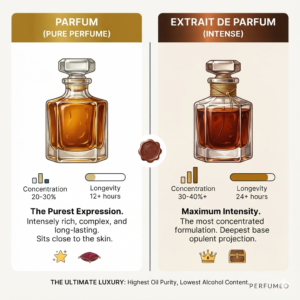
It is not always the loudest option, though. Counterintuitively, a high-concentration parfum often projects less aggressively than a sharp eau de toilette. It is intense up close, intimate rather than room-filling. That suits some people perfectly and quietly frustrates others.
Price reflects the oil load. Parfum costs the most per millilitre, which is why it usually arrives in smaller bottles. Cold weather and special occasions are its natural home. For a normal day at a desk, it can be a lot of fragrance.
Eau de Parfum (EDP)
If one tier has quietly become the UK default, it is Eau de Parfum.
EDP usually runs 15% to 20% oil, and that range is the entire reason it sells the way it does. Strong enough to last a working day, still there on your skin after eight or nine hours, without the wear-it-once-a-week intensity of a pure parfum. Most modern designer and Arabian releases now lead with an EDP for exactly that reason.
It is the safe recommendation. Ask anyone for a first proper fragrance, or a signature scent, and EDP is almost always the right answer.
Nearly all of the Lattafa range sits at this strength, which is a large part of why those bottles perform so well above their price. If you want specific examples, our guide to the best Lattafa perfumes runs through ten of them.
Eau de Toilette (EDT)
Eau de Toilette is the bright, easy, everyday tier, typically holding 5% to 15% oil.
An EDT opens with energy. The lighter concentration lets the top notes sparkle, which is exactly why so many citrus, aquatic and fresh green fragrances are built as toilettes rather than parfums. The trade-off is staying power: three to five hours is realistic, and a midday top-up is normal rather than a sign of failure.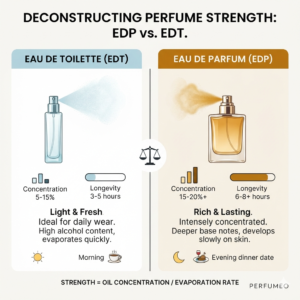
That suits more occasions than people give it credit for. Hot weather. The office. Daytime in general. An EDT that fits the moment beats a heavy parfum sweating its way through a July afternoon.
Eau de Cologne (EDC)
A word of caution on this one, because the name causes endless confusion.
Eau de Cologne is a strength, not a gender. It sits low on the scale, roughly 2% to 5% oil, and despite “cologne” being used loosely in everyday speech to mean any men’s fragrance, EDC is simply a light concentration. It traces back to the original 18th-century Cologne formula, a fresh blend of citrus and herbs splashed on liberally.
It still behaves that way. Light, crisp, mostly gone within two or three hours. You apply it generously and reapply without thinking twice.
For a hot day, a fast refresh, or anyone who finds modern fragrances overpowering, that is a feature rather than a flaw. It is also a gentle way into fragrance for anyone who finds an EDP too committal. The lower oil load makes an EDC easy to wear and easy to like, even if it asks for a top-up by lunchtime.
Eau Fraiche
The lightest tier of all is Eau Fraiche, and most shoppers will never deliberately set out to buy one.
At roughly 1% to 3% oil, it is barely a fragrance in the EDP sense. The real difference from an eau de cologne is that much of the dilution here is water rather than alcohol, which makes it gentle on reactive skin. Longevity is short, an hour or two at best.
Think of it as a scented refresh, not a signature. Post-gym, mid-heatwave, or for children and very sensitive skin, it has a clear and sensible place. As your one and only fragrance, it will disappoint you.
The Arabic concentrations Western guides skip
Here is where almost every UK strength guide stops. It is also where the subject gets genuinely interesting.
The five tiers above describe alcohol-based perfumery, the Western tradition. Arabian perfumery runs on a parallel system that is older, oil-based, and works to entirely different rules. If you have bought anything from a house like Lattafa, Ajmal or Swiss Arabian, you have already stepped into it, whether you realised it or not.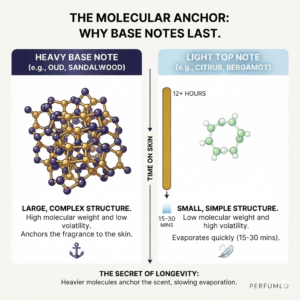
Attar
An attar, sometimes spelled ittar, is a concentrated perfume oil, traditionally with no alcohol at all. Classic attars are made by distilling botanicals (oud, rose, jasmine, musk) directly into a carrier oil, very often sandalwood. There is no percentage scale here in the Western sense. An attar is essentially pure aromatic oil.
The result is an intensity that makes a parfum look modest. A single touch to the wrist can last a full day and well beyond. Because there is no alcohol to carry it, the scent does not flash off in a bright opening. It unfolds slowly and stays close to the skin.
Application is a different habit from spraying, and it takes a wear or two to learn. The warmth of a pulse point, the inner wrist, the side of the neck, behind the ear, develops the oil and lifts it gently across the day. Newcomers almost always over-apply on the first attempt. One small dab is plenty. You can add more, but you cannot take it back.
A good attar also ages well. With no alcohol to evaporate and no fragile top notes to oxidise, a well-stored bottle stays true for years, which is rarely the case with a light eau de toilette.
Mukhallat
A mukhallat takes the idea further. The word means “mixture” or “blend” in Arabic, and that is exactly what it is: several oils, oud and rose and amber and musk among them, blended into one composition.
Where a single-note attar is a soloist, a mukhallat is the whole orchestra. These are the rich, layered, deeply traditional Arabian scents, oil-based, alcohol-free, and extraordinarily long-lasting. Many of the most prized Middle Eastern fragrances are mukhallats, and they are often passed down as something close to an heirloom.
Where modern Arabian EDPs fit
One nuance is worth knowing. Most modern Arabian houses, Lattafa included, mostly sell alcohol-based eau de parfum rather than traditional attars. They use the Western EDP format because it sprays easily and travels well.
But they tend to load it generously. An Arabian EDP often wears richer, and lasts longer, than a designer EDP at the very same stated concentration, because the oils used are heavier and the formulation is less restrained. The label says EDP. The experience leans closer to parfum.
You can explore both worlds in our Arabian fragrances range, and the oil-based alcohol-free perfumes sit in their own section for anyone with reactive skin.
Why the percentage ranges never quite agree
Compare three perfume guides and you will find three different sets of numbers. One says EDP is 15-20%. Another says 8-15%. A third puts parfum at 20-30%, a fourth as high as 40%. This is not sloppiness on anyone’s part. It is the actual situation.
There is no law fixing these percentages. No UK or EU regulation states that an Eau de Parfum must contain a specific oil concentration to use the name. The terms are industry convention, and every house sets its own. One brand’s EDT can genuinely be stronger than another brand’s EDP.
What regulation does cover is safety. Bodies like IFRA set limits on how much of certain aromatic ingredients a formula may contain, for the sake of skin safety, not to police marketing tiers. The EDT-versus-EDP label is the house’s own choice.
So treat any chart, the one above included, as a reliable general guide rather than a cast-iron guarantee. The only real test is wearing the thing.
How concentration affects what you pay
Strength and price move together, and the reason is straightforward once you see it.
Aromatic oils are the expensive part of any fragrance. Alcohol is cheap. A parfum at 30% oil therefore contains far more costly material per millilitre than an eau de toilette at 8%, and the price tag follows that maths closely. It is why a 50ml parfum routinely costs more than a 100ml toilette of the very same scent.
It also explains bottle sizes, something shoppers often find odd. Parfums tend to arrive in 30ml or 50ml bottles, partly because a 100ml would be eye-wateringly expensive, and partly because you use so little per wear that a small bottle still lasts months. Lighter concentrations come in 100ml and larger, because you apply more and reapply often.
There is a value lesson buried in here. Per millilitre, a parfum looks expensive. Per wear, it can work out cheaper than a toilette, because two small dabs do the job of eight sprays. Arabian fragrance plays this hand particularly well: a generously-oiled Arabian EDP often delivers parfum-level performance at an eau de toilette price, which is most of why the category has grown so quickly in the UK.
Cost per wear, not cost per bottle, is the number that actually matters.
Strength is not the whole story
One more correction, because it trips up a lot of shoppers.
A higher concentration tends to last longer. Tends to. It is not a guarantee, because concentration is only one lever among several.
Note composition matters just as much. A fragrance built on heavy base notes (oud, amber, musk, resins) will outlast a citrus-led one even at the same percentage, because those large molecules evaporate slowly. We covered that chemistry in our guide to whether perfume goes off, and it applies here too. A well-built EDT can genuinely outlast a poorly-built EDP.
Your skin plays its part as well. Drier skin holds fragrance less well than oily skin, which is why the same scent fades faster on some people than others. Where you spray, how much you apply, and the weather all feed into the result.
The label is a starting point. It was never a promise.
Which perfume strength should you actually buy?
Strip away the theory and the decision is fairly simple.
For an everyday signature, Eau de Parfum is the sensible default, and it is what most people should buy first. Strong enough, long enough, sensibly priced. It is hard to go wrong.
For hot weather, the office, or anyone who prefers a lighter touch, an Eau de Toilette does the job without overwhelming a room. For special occasions, cold evenings, or a scent you want to wear sparingly and memorably, Parfum earns its higher price.
And if you want genuine all-day intensity with no alcohol, and you do not mind applying carefully rather than spraying freely, an attar or mukhallat is the most rewarding choice of the lot. It is also the one most British shoppers have simply never tried.
Whichever way you lean, sample before you commit to a full bottle. The same scent in two strengths can smell noticeably different, not merely stronger, because a higher oil load shifts the balance between the top and base notes. A travel size or a decant is the cheap way to find out which version you actually want on your skin.
There is no single best strength. There is only the one that fits the bottle’s job. Match those two and you will rarely be disappointed.
FAQs
What is the strongest perfume concentration?
Among the standard Western tiers, Parfum or Extrait de Parfum is strongest, at roughly 20% to 40% aromatic oil. Traditional Arabic attars and mukhallats are more concentrated still, often close to pure perfume oil with no alcohol, which is why a single dab can last all day.
Is EDP or EDT better?
Neither is better outright. Eau de Parfum lasts longer and suits a daily signature scent, while Eau de Toilette is lighter and brighter, better for hot weather, the office, and fresh citrus styles. EDP is the safer first buy for most UK shoppers.
How long does each perfume strength last?
As a rough guide: Parfum lasts 8 to 12 hours or more, Eau de Parfum 6 to 9 hours, Eau de Toilette 3 to 5 hours, Eau de Cologne 2 to 3 hours, and Eau Fraiche 1 to 2 hours. Note composition and skin type shift these figures.
Does a higher concentration always mean longer-lasting perfume?
Usually, but not always. Concentration is one factor; note composition is another. A fragrance built on heavy base notes like oud and amber can outlast a citrus-led scent even at a lower concentration. Skin type and application also matter.
What is the difference between an attar and an Eau de Parfum?
An Eau de Parfum is alcohol-based, sprayed, and typically 15% to 20% aromatic oil. An attar is an alcohol-free concentrated perfume oil, often close to pure oil, applied sparingly to pulse points. Attars last considerably longer and project softly and close to the skin.
What does EDP stand for?
EDP stands for Eau de Parfum, French for “perfume water”. It is one of the most popular perfume strengths, typically holding 15% to 20% aromatic oil. EDT, by comparison, stands for Eau de Toilette, a lighter concentration of roughly 5% to 15%.
Why is parfum more expensive than eau de toilette?
Aromatic oils are the costly part of any fragrance, and parfum contains far more of them than an eau de toilette. A parfum can hold 20% to 40% oil against a toilette’s 5% to 15%, so it costs more per millilitre. Measured per wear, though, it often works out cheaper.
Want to compare concentrations on your own skin? From our shelves, Yara by Lattafa is a classic eau de parfum, Chaos Extrait by French Avenue shows what extrait strength feels like, and the Yara perfume oil demonstrates the concentrated oil format this guide describes. Related reading: does perfume go off?
Leave a Reply